
Hockessin, DE — June 26, 2025, one person was injured due to a truck accident at approximately 2:00 p.m. along Newport Gap Pike.
According to authorities, a pickup truck was traveling southbound on Newport Gap Pike in the vicinity between the Graves Road and McKennans Church Road intersections when the accident took place.
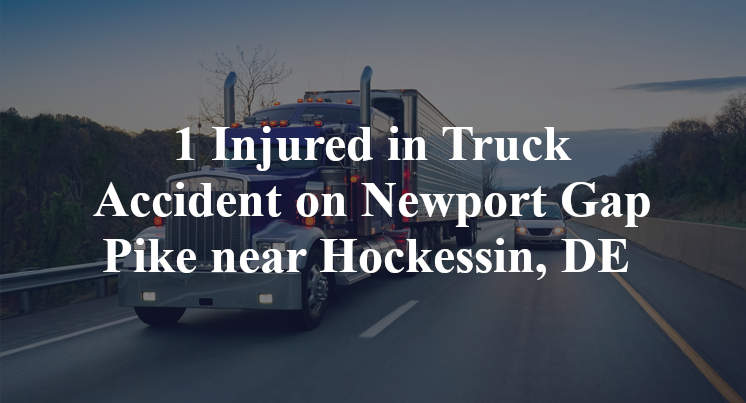
Officials indicate that, for as yet unknown reasons, the pickup truck failed to safely maintain its lane of travel. It allegedly veered left of center and was subsequently involved in a head-on collision with a northbound 18-wheeler.
The person who had been behind the wheel of the pickup truck was entrapped in the wreckage, according to reports, and had to be extricated by emergency personnel. Once freed from the aftermath they were transported to an area medical facility in order to receive immediate treatment for critical injuries incurred over the course of the accident.
Additional details pertaining to this incident—including the identity of the victim—are not available at this point in time. The investigation is currently ongoing.
Commentary by Attorney Michael Grossman
When a pickup truck crosses the center line and collides head-on with an 18-wheeler, most people will assume the pickup driver is to blame—and that may turn out to be the case. But that doesn’t mean there’s nothing left to investigate. In fact, that initial assumption can sometimes prevent deeper questions from being asked—questions that are necessary to understand what really happened.
To start, we don’t yet know why the pickup truck drifted out of its lane. Was the driver distracted? Did they suffer a medical emergency? Did a mechanical failure cause them to lose control? These aren’t speculative questions—they’re the kinds of facts that should be determined before assigning responsibility. That means investigators should already be looking into the pickup’s steering and braking systems, pulling cell phone records, and reviewing any available surveillance or dash cam footage.
On the other side of the equation, even though the 18-wheeler was traveling in its lane, that doesn’t automatically mean the driver had no role to play. For instance, how did the truck driver respond? Was there any evasive maneuver attempted, or were they caught completely off guard? That answer could depend on how visible the pickup was, how fast both vehicles were traveling, and how much time the trucker had to react. Engine control module (ECM) data and in-cab camera footage, if available, can help clarify those points.
There’s also the possibility that road design played a role. Newport Gap Pike isn’t a high-speed interstate—it’s a two-lane road with curves, elevation changes, and local access points. If the collision occurred near a blind bend or over a hill, that could have left both drivers with limited time to see and react to one another. Investigators should assess whether visibility or road geometry contributed to the collision—or limited options for avoiding it.
In my experience, what looks like a simple “vehicle crossed the line” case often turns out to be more complex. Maybe the pickup driver was having a medical episode. Maybe a tire blew. Maybe they were distracted by a phone. Or maybe the trucker had just enough time to take action—but didn’t. None of those possibilities can be ruled out until the facts are on the table.
Key Takeaways
- It’s still unknown what caused the pickup to cross the center line and enter the path of the 18-wheeler.
- Evidence like black box data, cell phone records, and mechanical inspections will be key to understanding the pickup driver’s condition and decisions.
- The truck driver’s ability to respond—and whether they did—also deserves scrutiny, even if they had the right of way.
- Road design, visibility, and curve geometry may have limited the reaction time available to either driver.
- True accountability depends on more than surface-level facts. It requires a full investigation into the moments leading up to the crash.

 call us
  Email Us
  Text us