
Collin County, TX — September 2, 2024, Ryan Hardison and three others were injured in a motorcycle versus car accident just before 7:30 p.m. on U.S. Highway 380.
According to authorities, 43-year-old Ryan Hardison was traveling on an eastbound Honda motorcycle on U.S. 380 approaching the County Road 557 intersection when the accident took place.
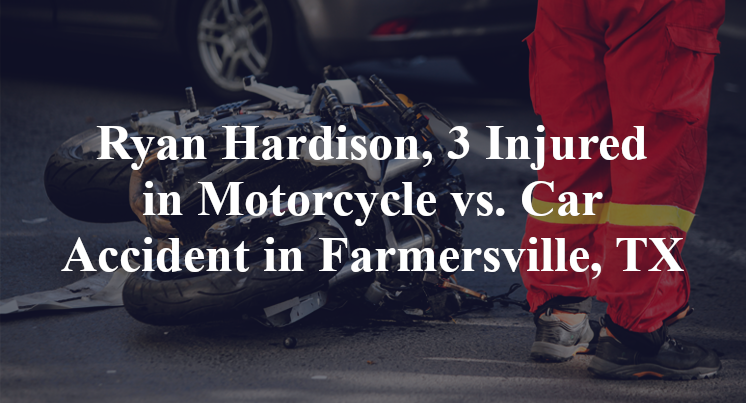
Officials indicate that, for as yet unknown reasons, a northbound Honda Accord—occupied by a 36-year-old woman, a 27-year-old man, and an infant girl—on C.R. 557 entered the intersection at an apparently unsafe time, failing to yield the right-of-way to highway traffic at a stop sign. This resulted in a collision between the front-end of the motorcycle and the back-left side of the Accord.
Hardison reportedly suffered serious injuries due to the wreck. The three from the Accord received minor injuries, as well, according to reports. Additional details pertaining to this incident are not available at this point in time.
Commentary by Attorney Michael Grossman
When a motorcyclist is seriously hurt in a crash involving a vehicle that allegedly failed to yield at a stop sign, as appears to have happened in this Collin County case, the natural tendency is to focus solely on driver error. But in my experience, these collisions are often more complex than they first appear. To get to the truth—and to ensure that those affected get the answers they need—there are three critical questions that must always be asked.
First, did investigators fully examine the conditions surrounding the crash? Saying a driver failed to yield doesn’t explain why it happened. Was the stop sign clearly visible and unobstructed? Were there environmental factors like glare, vegetation, or poor signage that could have interfered with the driver’s ability to see or judge the speed of oncoming traffic? The intersection’s layout, traffic volume, and visibility should all be documented, and nearby surveillance or dashcam footage should be reviewed. Without that kind of detailed analysis, important contributing factors may never come to light.
Second, has anyone considered whether a vehicle defect may have played a role? A mechanical failure—such as a problem with the brakes, steering, or throttle in the Honda Accord—could have prevented the driver from yielding even if they intended to. Likewise, if the motorcycle experienced any malfunction that affected braking or stability, that could have influenced the dynamics of the crash and the severity of the injuries. These types of failures often don’t leave obvious clues at the scene and can only be identified through a detailed forensic examination of the vehicles involved.
Finally, has all available electronic data been collected? Both the Honda Accord and many newer motorcycles may contain event data recorders or connected devices that log speed, braking, and throttle input leading up to the collision. That data can help confirm whether either party attempted to avoid the crash and how the vehicles were behaving in the moments before impact. Investigators should also seek out any cell phone, GPS, or video evidence that might clarify what happened, especially since a full understanding of the timing and positioning is often key to determining responsibility.
Answering these three questions is critical to making sure that no stone is left unturned in understanding the causes of a crash like this. Serious wrecks deserve serious investigation, not assumptions. Getting clear answers to these questions is crucial for those seeking to understand what happened and why—and it’s the least that can be done to help those affected find the clarity and closure they deserve.

 call us
  Email Us
  Text us