
Dumfries, VA — June 9, 2025, Three police officers were injured following an 18-wheeler accident that occurred around 12:00 A.M. on Interstate 95.
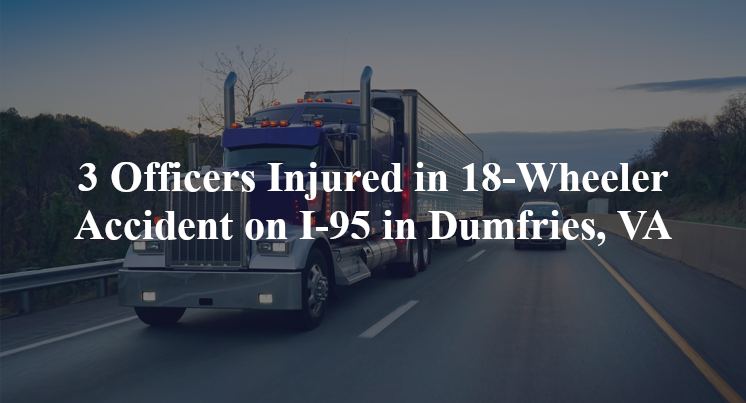
According to reports, three officers with the Prince William County police were injured when they were struck by an 18-wheeler on the southbound lanes of Interstate 95 near Joplin Road, the cause of which is still under investigation.
First responders transported all three officers to the hospital and they are expected to recover. Its unclear if the driver of the semi-truck will face any charges, and the identities of the officers have not yet been released.
Commentary by Attorney Michael Grossman
When an 18-wheeler strikes three police officers on the side of a major highway, the question isn’t just how it happened—it’s how it was even possible. At this time, officials haven’t explained what led to the crash, but that’s exactly the kind of detail that will determine whether the truck driver, the trucking company, or another factor is to blame.
Unanswered Questions
The incident took place on I-95 near Joplin Road in the southbound lanes, but reports don’t clarify whether the officers were in or outside their vehicles, whether they had lights activated, or whether traffic was already slowed. Those distinctions matter. If the officers were conducting a traffic stop or assisting a disabled vehicle, then the truck driver should have been aware and had time to respond.
We also don’t know the position or speed of the truck prior to impact. Was the driver distracted or fatigued? Was there poor visibility? Did the truck drift out of its lane or fail to move over? All of these possibilities raise very different legal questions.
Key Evidence That Needs to Be Reviewed
To get a full picture of what happened, investigators should be looking at:
- Engine control module (ECM) data to determine vehicle speed, braking, and throttle usage
- In-cab or dash camera footage, which may show whether the officers or their vehicles were visible ahead of time
- Driver’s cell phone records, to rule out distraction
- Hours of service logs, in case fatigue was a factor
- Crash scene measurements, including lane position and visibility conditions
In similar cases I’ve worked, ECM data and cell phone records were the turning points—often showing that a driver had ample time to react but failed to do so due to distraction or inattention.
Broader Legal Implications
Depending on what the investigation reveals, attention may shift from the driver’s actions to the company that put the driver on the road. Was this driver properly trained? Were they operating under a delivery schedule that made it difficult to drive safely? Did the company conduct regular safety evaluations, or were red flags ignored?
These are not peripheral issues—they go directly to the legal responsibilities of commercial carriers and how they monitor their drivers.
Key Takeaways
Accountability in this case hinges on what the facts reveal—not assumptions based on who was involved.
The cause of the crash remains under investigation, and key details—like what the officers were doing and how visible they were—haven’t been released.
Whether the driver was distracted, fatigued, or otherwise impaired remains an open question.
Critical evidence includes ECM data, camera footage, cell phone records, and hours of service logs.
The trucking company’s role in supervising, training, and scheduling the driver could be relevant depending on what’s found.

 call us
  Email Us
  Text us