

Minooka, IL — August 12, 2025, one person was injured due to a single-vehicle truck accident shortly before 5:45 p.m. along Interstate Highway 80.
According to authorities, an 18-wheeler was traveling eastbound on I.H. 80 in the vicinity just past Ridge Road when the accident took place.
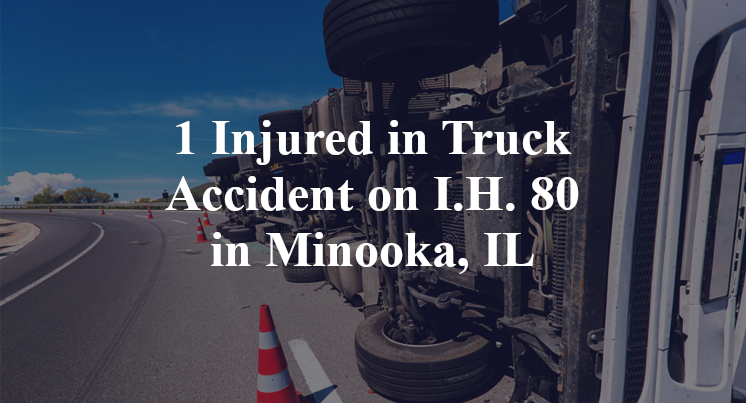
Officials indicate that, for as yet unknown reasons, the truck failed to safely maintain its lane of travel. It reportedly veered left and entered the median where it apparently overturned. The person who had been behind the wheel of the truck reportedly sustained injuries of unknown severity over the course of the accident; they were flown to a local medical facility in order to receive necessary treatment. Additional details pertaining to this incident—including the identity of the victim—are not available at this point in time. The investigation is currently ongoing.
Commentary by Attorney Michael Grossman
When a fully loaded 18-wheeler suddenly leaves its lane, crosses into the median, and overturns, there’s no shortage of possible explanations—but very few of them can be confirmed without a deeper look at the evidence. The official description here gives a rough outline, but the real story lies in the unanswered questions: What caused the truck to veer left? Was this driver reacting to something in the roadway? Was there a mechanical problem? Or was it a lapse in attention or control?
In my experience, crashes like this are often treated as if the driver’s actions alone are the starting and ending point of the investigation. That’s a mistake. A proper inquiry should begin with the truck’s engine control module (ECM) to see speed, braking, and steering inputs in the seconds leading up to the rollover. If the truck had in-cab cameras, those could reveal whether the driver was alert, distracted, or dealing with some unexpected hazard. Phone records are also essential—because if the driver was on a call or messaging, that could explain the loss of lane position.
Mechanical issues also can’t be ruled out without checking maintenance logs. I’ve seen cases where worn steering components or underinflated tires made a rig difficult to control, especially at highway speeds. When companies cut corners on inspections, drivers end up paying the price.
And then there’s the question of training and fitness for duty. Was this driver properly vetted before being hired? Was he under pressure to meet a tight deadline that may have pushed him past safe driving limits? In one case I litigated, a driver’s repeated lane departures turned out to be the result of untreated sleep apnea—something the company never screened for. It wasn’t just his problem; it was a failure of the system that put him behind the wheel.
For now, all we can say is that the truck didn’t stay in its lane and wound up on its side. But until investigators piece together the digital data, the maintenance records, and the company’s own oversight practices, the real cause—and any shared responsibility—will remain out of view.
Key Takeaways
- Lane departures by large trucks require a thorough review of ECM data, in-cab video, and phone records to determine cause.
- Mechanical issues and maintenance history should be examined alongside driver behavior.
- Hiring, training, and medical fitness are possible contributing factors that must be scrutinized.
- Without preserving and analyzing electronic and company records, the true chain of events will remain unclear.
- A proper investigation must look beyond the driver to see if company policies or oversights played a role.
 call us
 Email Us
 Text us