

Western Springs, IL — July 1, 2025, one person was killed due to a motorcycle versus truck accident sometime in the afternoon along I.H. 294.
According to authorities, the accident took place on Interstate Highway 294 in the vicinity of Ogden Avenue.
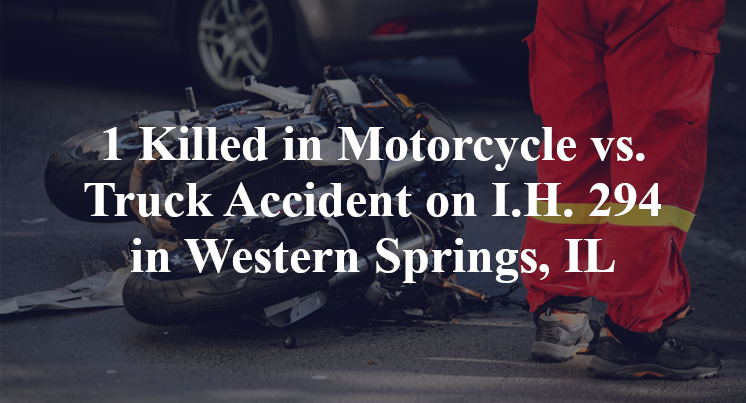
Details surrounding the accident remain scarce. Officials indicate that, for as yet unknown reasons, a collision took place between a motorcycle and an 18-wheeler. Preliminary reports state that one person lost their life as a result of the wreck. Additional information pertaining to this incident—including the identity of the victim—is not available at this point in time. The investigation is currently ongoing.
Commentary by Attorney Michael Grossman
When a motorcyclist is killed in a collision with an 18-wheeler on a major highway, most people instinctively want to know which vehicle made the critical mistake. But with so little known so far, the more useful question is how did two such vastly different vehicles end up in the same space at the same time with no room to recover? The answer to that will depend on a careful review of timing, lane position, and reaction opportunity—because crashes like this rarely happen in isolation.
Motorcycles are small and agile, but also easy to miss. That makes them especially vulnerable around commercial trucks, whose large blind spots, wide turns, and longer stopping distances create situations where even a brief lapse in awareness can be fatal. But this vulnerability doesn’t automatically place fault on the truck driver—or the rider. What matters is what each party could see, what they were doing, and what choices they had in the final moments before the crash.
That’s why evidence like dash cam footage, lane tracking data, and the truck’s engine control module (ECM) are so important. Did the motorcyclist attempt to pass the truck? Was the truck merging or changing lanes? Was one of the vehicles stopped or slowing for traffic? Those answers can’t be guessed at—they need to come from data.
In past cases I’ve worked on, seemingly “simple” motorcycle-versus-truck crashes turned out to involve multiple points of failure: blind lane changes, missed signals, sudden stops, or even debris in the roadway that caused a rider to swerve into harm’s way. It’s especially critical to determine whether either vehicle changed lanes, and if so, whether it was done safely and with adequate warning.
The design of the roadway should also be reviewed. Did the curve, grade, or shoulder width near Ogden Avenue limit visibility or leave the motorcyclist with fewer options to maneuver? Sometimes a rider is technically in the right lane position but still has no escape route when traffic shifts. If poor road design contributed, that’s something investigators need to document.
At this point, speculation doesn’t help anyone. The only way to understand what went wrong—and who bears responsibility—is through a complete reconstruction grounded in evidence, not assumptions.
Key Takeaways
- The central issue is how the motorcycle and 18-wheeler came into conflict and whether either driver could have avoided the collision.
- Dash cams, ECM data, and any eyewitness accounts will be key to understanding movement and timing.
- The truck’s blind spots, stopping distance, and maneuvering room must be weighed against the motorcyclist’s visibility and reaction options.
- Road design and traffic conditions near the scene may have limited escape routes or contributed to driver error.
- Assigning accountability requires a full investigation into the actions of both drivers and the environment they were navigating.
 call us
 Email Us
 Text us